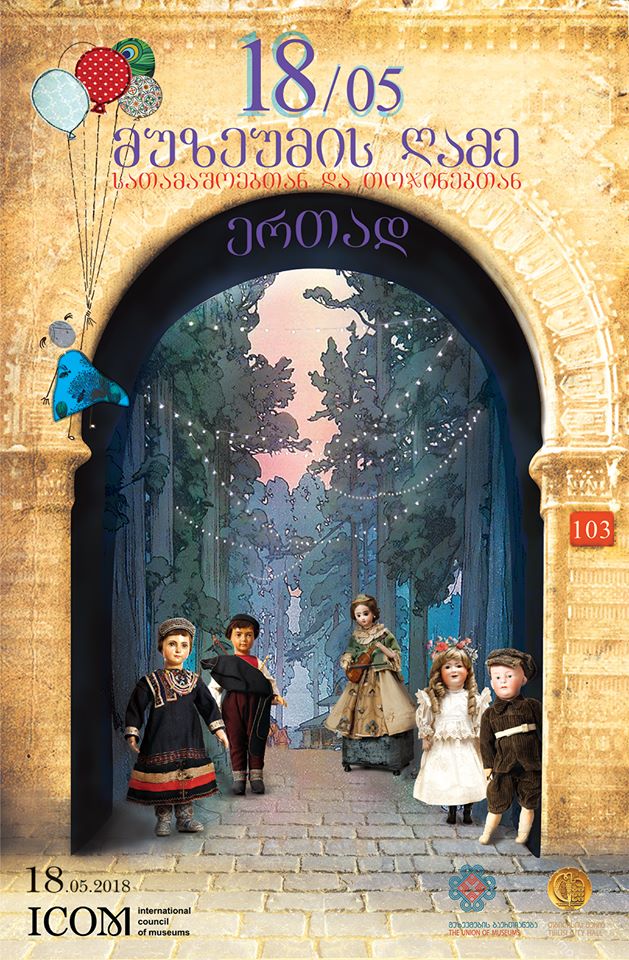
During the Museum Night event on May 18, 2018, the Tbilisi Museums Union organized an elaborate program titled “Museum Night with Dolls and Toys.” The event includes a theatrical spectacle dedicated to the 80th anniversary of the Tbilisi Dolls and Toys Museum.
The main component of the event is the game “Assembling the Exhibition of the Tbilisi Dolls and Toys Museum”. Visitors will have the opportunity to participate in the game in the assembly of the virtual exposition of the Tbilisi Dolls and Toys Museum in the exhibition space specially organized in advance.
The book “Tbilisi Dolls and Toys Museum” will be presented.
This book stands as a distinctive publication, compiling museum exhibits, ancient Georgian games, and toys sourced from various regions of Georgia, alongside previously undisclosed facts. It’s a bilingual volume, presented in both Georgian and English, featuring vibrant illustrations showcasing collections stored within the museum’s archives. Released in honor of the 80th anniversary of the founding of the Tbilisi Dolls and Toys Museum.
The event “Museum Night with Dolls and Toys” will be attended by representatives of the Tbilisi City Hall, deputies of the Tbilisi City Council, members of the Government of Georgia, representatives of the diplomatic corps, and other guests.
The Tbilisi Dolls and Toys Museum was established in 1937, situated in a kindergarten on Atharbegov Street. Its inception was led by children’s writer and educator Tinatin Tumanishvili (1892-1966) and owed its existence to the remarkable decision made by the Government of Georgia. Over time, the museum has shifted locations several times. Initially, in 1958, it relocated to the Palace of Student Youth (formerly Pioneers). From 1986, it occupied a building on Shavteli Street, and since 2012, it has been situated at 103-107 Aghmashenebeli Avenue.
The first “Museum Night” debuted in 1997 in Berlin, sparking a tradition adopted by 120 European cities. Berlin’s Museum Night occurs two times a year—both in winter and summer—encompassing hundreds of museums, archives, memorial homes, galleries, and various cultural venues. These institutions collectively host a diverse array of activities for visitors of all ages. The events encompass special tours, engaging lectures, masterclasses, film screenings, classical and jazz music evenings, theater performances, and many other activities that typically don’t take place during regular museum hours.
The popularity of these cultural gatherings led the French Ministry of Culture and Communications to establish the “European Night of Museums” in 2005. Since 2011, over 4,000 museums across 40 European countries have actively participated in this international museum initiative, which is organized in collaboration with the Council of Europe, UNESCO, and ICOM (International Council of Museums). By using the resources and venues of museums and exhibition spaces, organizing such events aims to broaden museums’ audiences and promote the significance of museums, their collections, and the overall impact of museum endeavors.
The term “hyperconnected” emerged in 2001 to describe the intricate web of modern communication methods like face-to-face interactions, emails, instant messaging, telephone conversations, and beyond. This global network of communication continually evolves, growing more diverse and interconnected each day. Museums are also embracing this trend, integrating into the hyperconnected landscape of the contemporary world. ICOM selected “Hyperconnected Museums – New Approaches, New Audiences” as the theme for International Museum Day 2018. Since 2011, ICOM has supported the European Night of Museums, an annual celebration observed on the Saturday closest to International Museum Day. This year, the Night of European Museums will take place on May 19, 2018. Established in 2005 by the French Ministry of Culture and Communications, this event urges museums to offer free admission to the public, remaining open until 1:00 a.m. During these nighttime hours, museums showcase their collections through innovative and sensory approaches.
During the Night of European Museums, museums offer a range of nighttime activities, including educational guided tours, interactive games, workshops, video screenings, tastings, live performances, and special animations. These diverse engagements allow the public to actively learn about and immerse themselves in the museum experience. In 2017, over 3,800 museums across 30 European countries participated in this event.